

Sindh Government Jobs in 2026: What Early-Career Applicants Need to Know
Sindh government jobs remain one of the most searched career paths for students and fresh graduates. Many people want stable income, clear promotion rules, and work that matters to the public. In 2026, the hiring picture is shaped by two routes: direct department hiring and SPSC recruitment. If you understand both, you save time and avoid missed deadlines.
This guide explains the full process in plain language. You will see which posts are open to early-career applicants, what documents matter, how the quota system works, and how to prepare for tests and interviews. If you are looking for public sector jobs in Sindh or government jobs in Karachi 2026, this page will help you start from the right place.
Sindh has a large public workforce across health, education, local government, revenue, police, support services, and technical departments. Some vacancies appear on department websites. Others are announced through the Sindh Public Service Commission. A few are contract or project posts with short timelines. The route matters because the eligibility rules, test pattern, and final selection method can change from one post to another.
For related reading, you can also check current jobs on Trainee.in, the career guides section, and our CV writing guide.
Types of Sindh Government Jobs
Not every government post is handled the same way. This is where many applicants get confused. If you know the type of vacancy first, you can prepare the right documents and the right test material.
1. Direct departmental recruitment
These vacancies are posted by a department, district office, or project unit. The department may collect forms online or by hand. Some posts need a written test, while others use shortlisting and interviews. Clerical, support, and junior technical roles often fall in this group.

2. SPSC recruitment
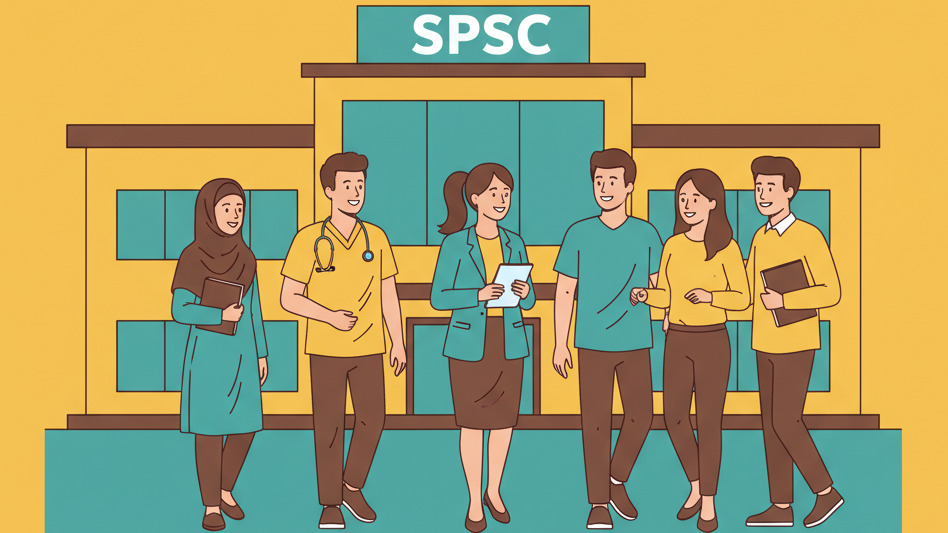
SPSC jobs 2026 usually cover gazetted posts and many competitive roles in provincial civil services. The Sindh Public Service Commission was established as the constitutional recruiting body under the 21st Constitutional Amendment in 2015. That makes it central to many hiring routes in Sindh. SPSC is also a large organization, with 14 departments and branches that handle exams, recruitment, and administration (2025).

3. Contract and project hiring
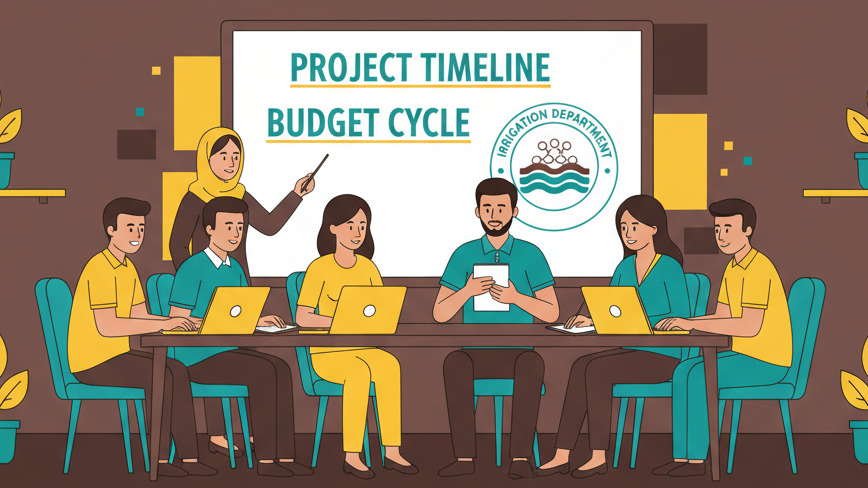
These posts are tied to a project, budget cycle, or donor-funded program. They may offer good learning and decent pay, but they are not always permanent. The job notice should clearly say whether the role is regular, contract-based, or project-based.
4. Quota-based provincial hiring
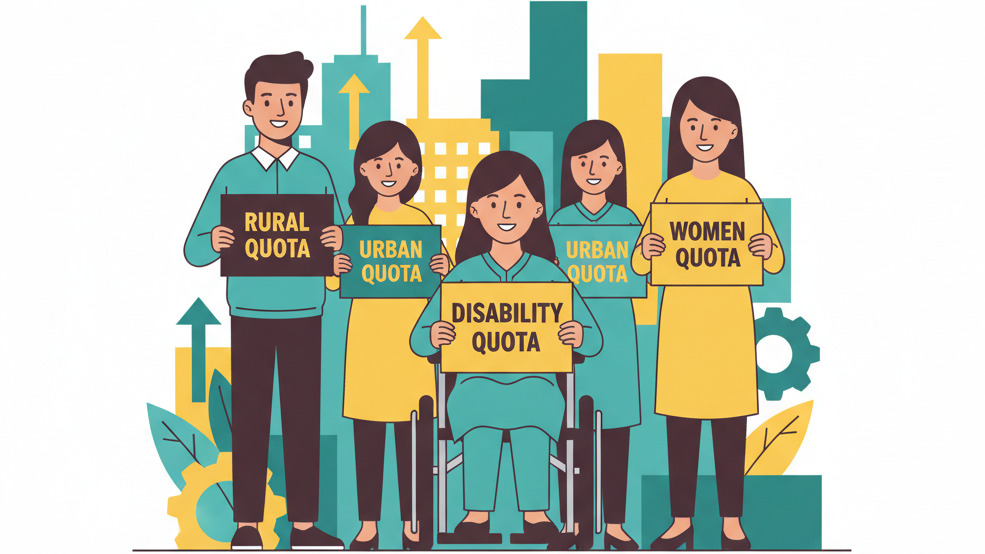
Many Sindh government job vacancies are filled under quota rules. Common categories include rural, urban, women, minority, and disability quotas (2026). This is a key search point for applicants because the quota can change your eligibility and your chances of selection.
For vacancy alerts and local hiring updates, keep an eye on the Trainee.in blog and the relevant department notices.
Key Sindh Government Departments and Their Roles
Different departments hire for different kinds of work. Knowing the function of each department helps you target your search.
- Education Department — school teachers, clerical staff, district education officers, and support posts.
- Health Department — nurses, medical officers, technicians, paramedics, data entry staff, and hospital support roles.
- Local Government and Municipal bodies — sanitation, engineering support, water supply, administration, and field roles.
- Revenue Department — land records, assistant roles, and district administration support.
- Police and Home Department support units — clerical, IT, procurement, and back-office work.
- Irrigation, Works, and Transport — technical, field, and junior engineering roles.
- Planning and Development / Project Units — contract roles, monitoring, and administrative support.
For early-career candidates, the easiest entry points are usually clerical, assistant, junior technical, education support, health support, and district-level posts. Higher-status roles often need SPSC clearance, a professional degree, and strict quota compliance.
SPSC vs Direct Department Recruitment: How Hiring Works
Many applicants search for the Sindh government jobs application form and assume every form works the same way. It does not. The route to the appointment changes the whole process.
SPSC recruitment
SPSC usually handles competitive, merit-based selection for many provincial posts. You may need to SPSC apply online, pay a challan, upload documents, and sit for a screening test or written exam. Shortlisted candidates then move to interviews, document checks, and final recommendation.
Direct department recruitment
Here, the department runs the process. The notice may appear on its website, in newspapers, or on a job portal. Some departments use simple application forms. Others ask for online registration, skill tests, or walk-in interviews. Always read the ad line by line.
Contract and urgent recruitment
Project posts can move faster. They may use written tests, skill checks, or only interviews. Because these jobs are time-sensitive, candidates often miss them by waiting for the wrong portal or the wrong announcement channel.
The main rule is simple: do not assume every Sindh government job goes through the same gate. Read the source, confirm the hiring authority, and match your documents to that process.
Eligibility Criteria for Sindh Government Jobs
The eligibility criteria for Sindh government jobs are role-specific, but the same basic rules come up often. Most ads ask for Sindh domicile, Pakistani citizenship, the right education, and age within the stated range. Some posts also need experience, a registration certificate, or a physical standard.
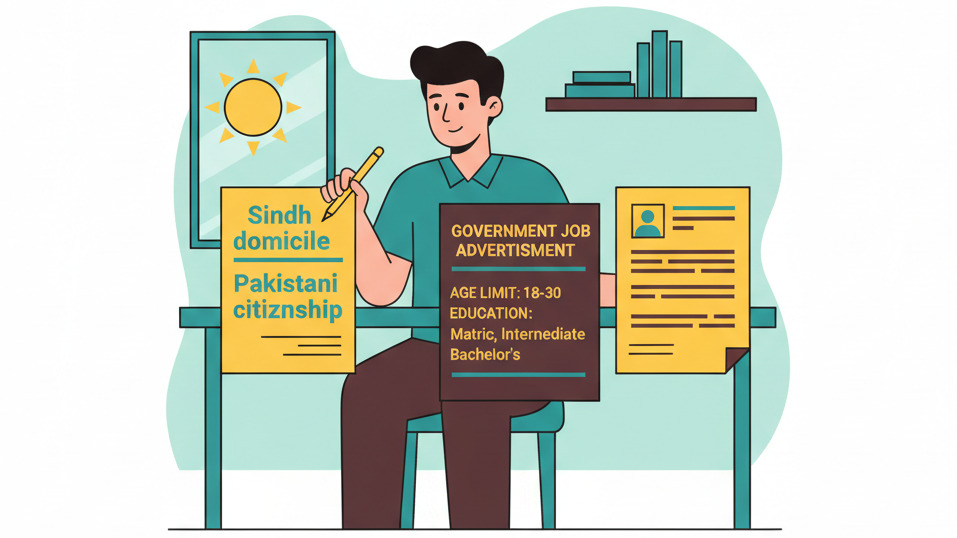
- Domicile: Usually, a Sindh domicile is required for provincial posts.
- Citizenship: Most posts require Pakistani citizenship.
- Education: Matric, Intermediate, Bachelor’s, Master’s, or a professional degree, depending on the job.
- Age limit: The Sindh government jobs age limit depends on the ad. Age relaxation may apply in some cases.
- Experience: Some senior, technical, or specialist roles ask for prior experience.
- Registration: Health and technical roles may require professional registration or equivalent proof.
Age relaxation matters a lot. Sindh recruitment rules have historically allowed broad age-relaxation policies for certain categories and candidates, and some notifications have allowed up to 15 years in specific cases (2025). But this always depends on the advertisement and the applicable rules set. Never rely on old advice from a friend. Check the current notice.
Domicile, Quota, and Age Relaxation Rules
Quota rules are one of the most searched topics around the Sindh government jobs domicile requirement. They are also one of the most misunderstood. If you get the quota wrong, you may be rejected even if your marks are strong.
Domicile and PRC proof
Many notices ask for domicile, PRC/Form-D, or another proof of residence and district claim. The exact requirement depends on the post and the department. Keep scanned copies ready before the form opens.
Common quota categories
- Rural quota
- Urban quota
- Women quota
- Minority quota
- Disability quota
These categories affect shortlisting and final merit. For some posts, a candidate may qualify under more than one category. For others, the advertisement sets a fixed split. Read the breakdown carefully.
What to check before applying
- Does the ad mention rural or urban district placement?
- Does the post require Sindh domicile only?
- Is there a special quota for women, minorities, or the disabled?
- Is age relaxation available for this specific role?
- Is there any district-specific or board-specific preference?
This step saves you from avoidable rejection. It also helps you decide whether the job is actually open to you.
How to Apply for Sindh Government Jobs Step by Step
If you want to learn how to apply for Sindh government jobs, start with the ad, not the form. Most mistakes happen before the application is even opened.
- Read the full advertisement. Check the department, last date, eligibility, and test method.
- Confirm the hiring route. Decide whether it is SPSC, departmental, or contract-based recruitment.
- Prepare your documents. Scan them clearly in the required format.
- Create the account or fill out the form. Use your own email and mobile number.
- Enter data exactly as it appears. Match your name, CNIC, marks, and dates.
- Upload the right files. Many applications fail because the wrong certificate or photo is attached.
- Pay the fee if required. Keep the challan or receipt safe.
- Submit before the deadline. Do not wait until the final hour.
- Save a copy of the form. You may need it for the test or interview.
For online applications, form-filling accuracy is more important than design or formatting. One small mistake in the date of birth, district claim, or qualification can create problems later. If the portal gives a preview screen, review every line before final submission.
Documents You Need Before Applying
Document readiness is one of the biggest differences between serious applicants and casual applicants. The good news is that most documents are standard. If you keep them ready in advance, you can apply faster when a vacancy opens.
- CNIC
- Sindh domicile
- PRC/Form-D or equivalent proof, if required
- Matric and intermediate certificates
- Degree and transcripts
- Equivalence certificate, if your degree is from another board or university system
- Experience letters, if the post asks for them
- Passport-size photo
- Professional registration certificate, if relevant
- Disability certificate, minority claim, or other supporting proof, if applicable
Keep both scanned and printed copies. Use clear file names like “CNIC-front,” “Domicile,” and “Degree-final.” That small habit saves time during online submission and later verification.
How to Prepare for SPSC Exams
SPSC preparation should be practical. Do not waste weeks on generic exam quotes or random PDFs. The best approach is to study the actual syllabus, practice MCQs, and work on weak areas early.
What to study
- English grammar and comprehension
- Current affairs
- Pakistan affairs
- Basic mathematics
- Analytical reasoning
- Subject-specific knowledge from the ad
The Sindh public service commission syllabus can vary by post, so always match your study plan to the advertisement. A clerk test is not the same as a lecturer test. A health post is not the same as an administrative post.
How to use past papers
SPSC past papers are useful because they show repeated patterns. Look for question style, topic weight, and timing pressure. If you can, solve at least three sets under timed conditions. Then check which topics slow you down.
A simple study plan
- Read the syllabus and divide it into sections.
- Spend more time on your weakest two topics.
- Practice timed MCQs every day.
- Review current affairs from reliable news sources.
- Revise Pakistan affairs and basic math twice a week.
- Do one mock test before the real exam.
If you need structured learning, you can use Coursera, Google Career Certificates, and local study groups for basic computer or office skills. For exam-specific work, focus more on the ad, the syllabus, and repeated practice than on general career advice.
SPSC Syllabus, Past Papers, and Study Strategy
A strong SPSC score comes from consistent preparation, not cramming. Most candidates lose marks because they study too many things at once. Keep the plan narrow.
Use this order:
- Advertisement and syllabus
- Past papers
- Topic revision
- Mock tests
- Interview preparation
For English, work on sentence correction, vocabulary in context, and reading comprehension. For reasoning, practice sequences, analogy questions, and simple logic. For math, focus on percentage, ratio, average, and basic word problems. These are common in screening tests.
For current affairs, read short daily updates instead of long archives. For Pakistan affairs, focus on the constitution, institutions, basic history, and provincial structure. This is enough for many screening-level exams.
Crafting a Winning CV for Government Roles
A government CV in Pakistan should be clean, plain, and easy to scan. Do not use heavy graphics or fancy layouts. Screening teams want to see facts, not design.
Include your academic record in reverse order. Add certifications, computer skills, internships, volunteer work, and any public-sector relevant experience. If you studied at a university with a strong office or field attachment, mention it clearly. Keep the chronology simple and honest.
What to include
- Full name and contact details
- CNIC or national identity reference, if asked
- Education with marks, board, and year
- Professional certifications
- Computer skills like MS Word, Excel, and basic data entry
- Internships, field work, or volunteer roles
- Languages and district information, if relevant
A good CV also helps with manual review. Many government offices still use printed files. A clear, one-page or two-page CV is easier to understand than a long, decorative one. If you want help, use the Trainee.in CV writing guide for a cleaner layout.
Interview Strategies for Public Sector Jobs
Public-sector interviews are usually formal and direct. The panel may ask about your background, the department, your subject knowledge, and your reason for applying. They may also test your ability to speak clearly and follow instructions.
How to answer well
- Speak in short, clear sentences.
- Answer the exact question first.
- Do not over-explain.
- Show basic knowledge of the department’s role.
- Be honest about gaps in experience.
If the role is in health, education, local government, or administration, review the department’s main function before the interview. For example, if you are applying for a district office post, learn how that office serves the public and what the daily work looks like.
Dress simply and neatly. Bring original documents, extra copies, and your application receipt if you have one. If they ask about career plans, keep your answer practical. You can say you want stable work, public service experience, and room to grow through performance.
Career Growth in Sindh Government
Career growth in the Sindh government can be slow, but it is steady in many departments. Promotion usually depends on seniority, performance, exams, availability of seats, and service rules. Some cadres move faster than others.
Early-career roles often start in the clerical, assistant, health support, or junior technical range. Over time, a good record can lead to scale upgrades, better postings, and supervisory roles. Mid-level officer roles through competitive recruitment often fall around PKR 80,000–180,000 per month, depending on grade, department, and posting. Senior bureaucratic or specialist technical positions can move beyond PKR 150,000 per month, especially with allowances and higher scales.
For a rough market view in Pakistan:
- Entry-level clerk, assistant, junior admin roles: PKR 35,000–70,000/month
- Teaching and school administration roles: PKR 45,000–120,000/month
- Health department roles for nurses, paramedics, technicians: PKR 40,000–140,000/month
- Mid-level officer roles through competitive recruitment: PKR 80,000–180,000/month
- Senior bureaucratic or specialist technical positions: PKR 150,000+/month
These are broad ranges. Take-home pay changes with scale, allowances, station, and whether the post is regular or contract-based. If you want a deeper comparison, check salary trends on Trainee.in.
Common Mistakes to Avoid
Many candidates lose chances because of simple errors. These mistakes are common and easy to avoid.
- Applying without checking the correct hiring route.
- Missing the last date because you waited too long.
- Uploading blurry or wrong documents.
- Ignoring quota or domicile rules.
- Using a flashy CV that is hard to read.
- Studying random exam material instead of the actual syllabus.
- Skipping past papers and mock tests.
- Forgetting to keep application copies and receipts.
One more common problem is using the wrong language in forms and interviews. Keep your answers simple. Do not try to sound too formal. Clear English or clear Urdu is better than stiff wording that hides the real point.
Frequently Asked Questions
What is the difference between Sindh government jobs and SPSC jobs?
Sindh government jobs include all provincial department vacancies. SPSC jobs are a subset of posts recruited through the Sindh Public Service Commission, usually for competitive selection and gazetted roles. Some posts are filled directly by departments instead of SPSC.
Who is eligible for Sindh government jobs?
Eligibility depends on the post, but most roles require Sindh domicile, Pakistani citizenship, the relevant educational qualification, age within the prescribed range, and any required experience or professional registration.
Do all Sindh government jobs require a test?
No. Many do, especially SPSC-recruited roles and screened positions. Some contract or urgent posts may use shortlisting and interviews, while technical roles may include skill tests.
How can I prepare for SPSC exams?
Focus on the advertised syllabus, past papers, English, current affairs, Pakistan affairs, subject-specific knowledge, basic mathematics, and analytical reasoning. Practice timed MCQs and review the department role for interview preparation.
What documents are usually required to apply?
Common documents include CNIC, domicile, educational certificates, transcripts, passport-size photos, experience letters if required, and any professional registration or equivalence certificate stated in the advertisement.
Are Sindh government jobs permanent?
Not always. Some are permanent, some are contract-based, and some are project posts. The job advertisement and appointment letter determine tenure and terms.
Conclusion
Sindh government jobs can offer stable work, clear rules, and a long-term career path for early-career applicants. The key is to understand the hiring route, check the eligibility rules, and prepare documents before the vacancy opens. If the post is SPSC-based, focus on the syllabus and past papers. If it is a departmental or project post, read the notice with extra care.
Good preparation also means a clean CV, honest form-filling, and a simple interview style. Once you know how the system works, the process becomes easier to manage. For more support, visit current job listings and the Trainee.in blog for more career guides and updates.
