


Why Prompt Engineering Matters for Your Career Right Now
Prompt engineering isn't just for AI specialists anymore. It's become a baseline skill that helps trainees and early-career professionals stand out in competitive job markets across Pakistan, India, and the UAE. Think of it as learning to ask the right questions to get the right answers—a skill that applies to everything from tailoring your resume to preparing for interviews.
The 2026 job market has shifted. While critical thinking tops hiring priorities for 75% of leaders (per Korn Ferry's Talent Acquisition Trends), the ability to work effectively with AI tools is now expected across sectors like government, aviation, retail, and fintech.
This guide walks you through prompt engineering fundamentals and shows you exactly how to apply them to your job search, applications, and early career roles.
Who This Guide Is For
You're a trainee, intern, or early-career professional in Pakistan, India, or the UAE looking to level up your job search and career prospects. You might be:
- Preparing your resume and cover letter for competitive roles
- Getting ready for interviews in tech, fintech, or corporate sectors
- Exploring remote or project-based opportunities in the UAE or beyond
- Wanting to understand how AI tools can accelerate your career growth
- Curious about in-demand skills without formal AI certifications
You don't need coding experience or a technical background. This guide assumes zero AI knowledge and builds from there.
Step-by-Step Roadmap to Mastering Prompt Engineering
1. Understand What Prompt Engineering Actually Is
A prompt is simply an instruction or question you give to an AI tool (like ChatGPT, Claude, or similar). Prompt engineering is the skill of writing clear, specific prompts to get useful, accurate responses.

Example: Instead of asking "Help me with my resume," a better prompt is: "I'm a marketing trainee in Karachi with 6 months' experience in social media. Rewrite my resume summary to highlight ROI-driven campaigns for UAE fintech roles." The second prompt gives the AI context, your goal, and what you want—so you get a more targeted result.
Why does this matter for your career? Because the clearer your prompts, the better the output. And better outputs save you time and help you communicate more effectively—both critical for early-career success.
2. Learn the Core Prompt Engineering Techniques
There are a few simple techniques that work across any AI tool:
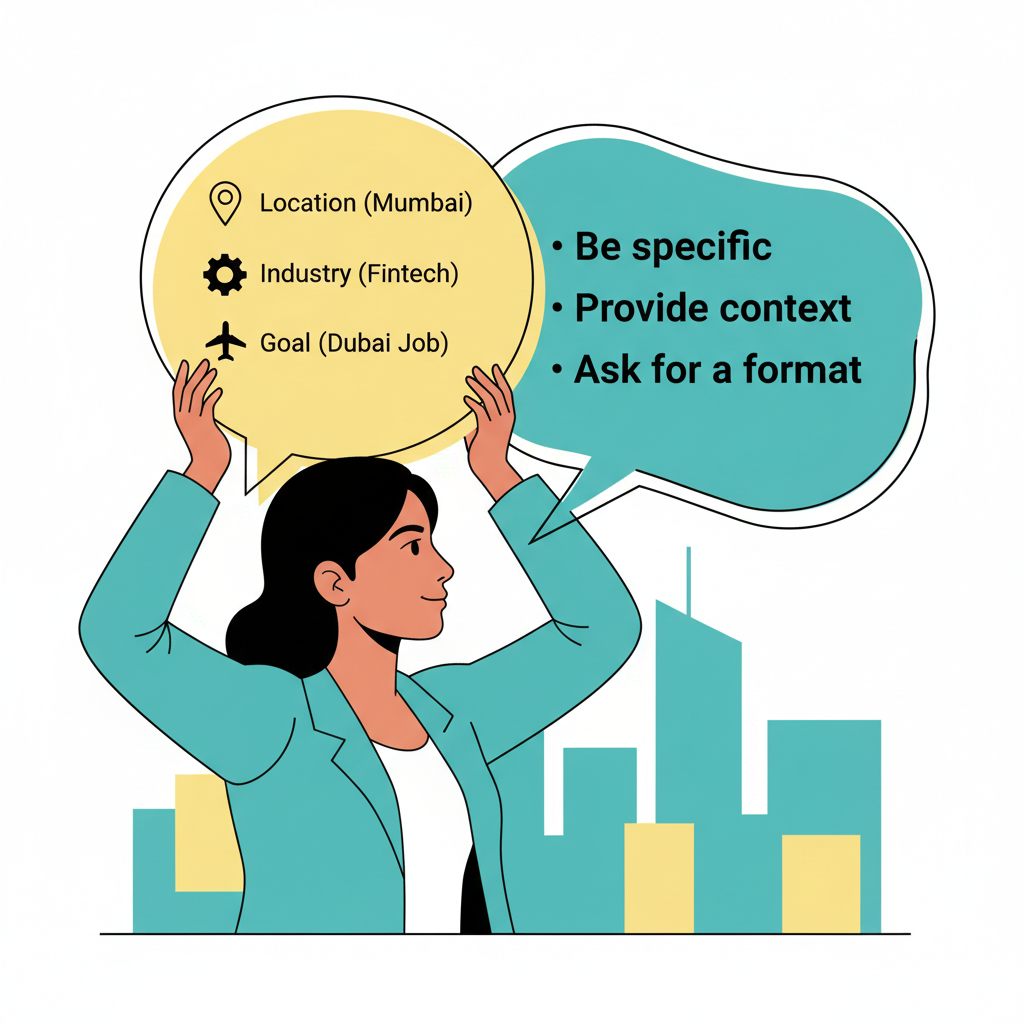
- Be specific: Include your role, location, industry, and goal. "I'm a finance trainee in Mumbai applying for a Dubai fintech role" beats "Help me apply for a job."
- Provide context: Share your background, experience level, and what you're trying to achieve. AI tools work better when they understand your situation.
- Ask for a format: Request bullet points, a paragraph, a table, or a script. "Give me 5 interview answers in bullet-point format" is clearer than "Give me interview answers."
- Iterate: If the first response isn't quite right, refine your prompt. "That's too formal—make it more conversational" or "Add more numbers and metrics" guides the AI to improve.
These techniques work whether you're using AI to brainstorm career ideas, draft emails, or prepare for interviews.
3. Apply Prompt Engineering to Your Job Search
Your job search involves multiple stages: finding roles, tailoring applications, preparing for interviews, and negotiating offers. Prompt engineering speeds up each stage.
Finding the right roles: Use prompts like "List 10 entry-level fintech roles in Dubai that hire Pakistani trainees. Include salary ranges in AED and required skills." This saves hours of job board scrolling and gives you a focused list.
Tailoring your application: Instead of using a generic resume for every role, prompt: "I'm applying for a project coordinator role at a UAE free zone. My background is in operations and I speak Urdu and English. Rewrite my resume to emphasize project management and cross-cultural communication." You get a version that speaks directly to that employer's needs.
4. Use Prompt Engineering to Prepare for Interviews
Interview prep is where prompt engineering really shines. You can generate realistic questions, practice answers, and get feedback—all before you sit down with a hiring manager.
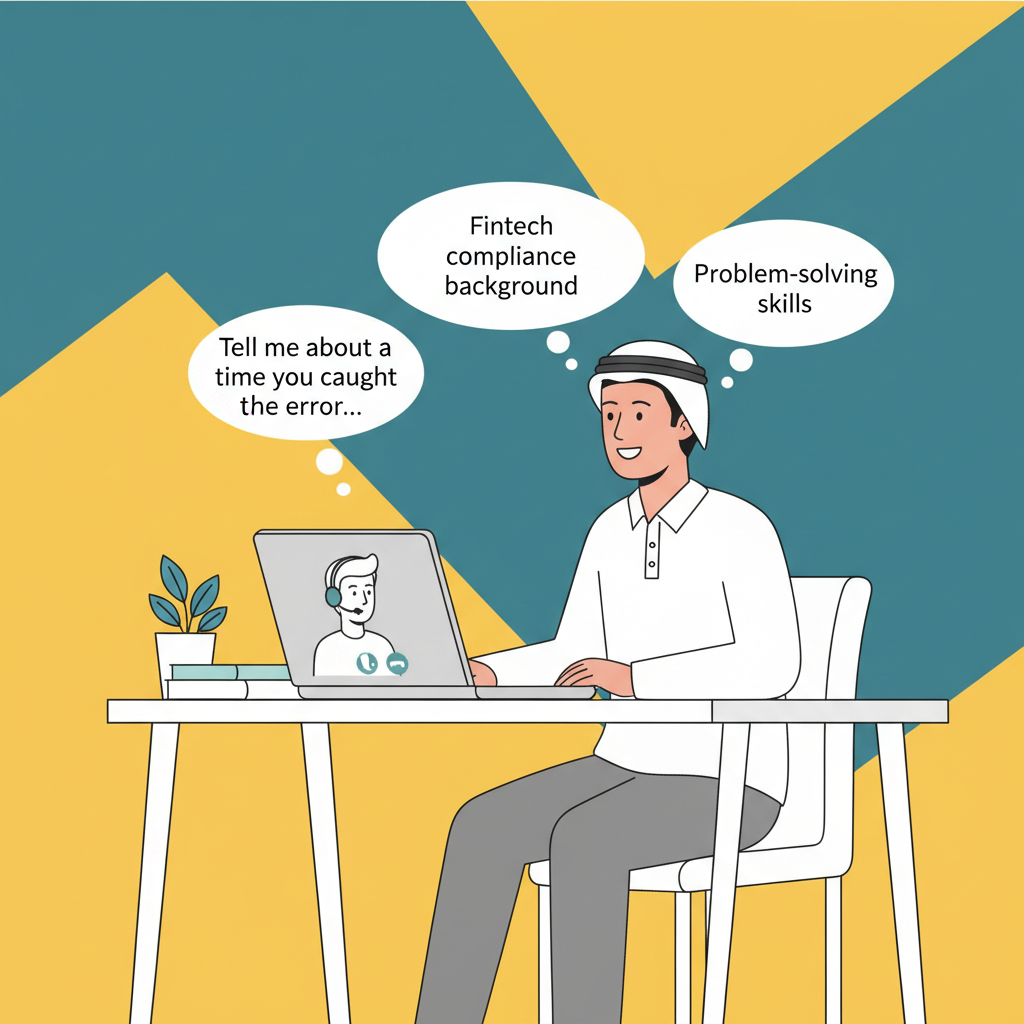
Example prompt: "I'm interviewing for a fintech compliance trainee role in Abu Dhabi. I have 8 months of experience in banking operations. Generate 8 behavioral and technical interview questions they might ask, plus tips for answering each one."
Then refine: "Now give me a 2-minute answer to the question 'Tell me about a time you caught an error that could have cost the company money.' Make it specific to fintech and compliance."
5. Build Your AI Literacy Beyond Prompts
Prompt engineering is one part of AI literacy. The broader skill involves understanding how AI tools work, their limits, and when to use them—and when not to.
For your career, this means:
- Knowing which tasks AI can speed up (brainstorming, drafting, research) and which require human judgment (final decisions, creative strategy, relationship-building)
- Understanding that AI outputs need fact-checking—especially for salary data, company details, or industry trends
- Recognizing that AI literacy is now baseline across UAE sectors (government, aviation, retail, fintech) and increasingly expected in Pakistan and India
- Staying curious about new tools and updates—the landscape changes fast
6. Practice Prompt Engineering on Real Career Tasks
Don't just read about this—try it. Pick one task from your current job search or role and use a prompt to tackle it. Here are realistic scenarios:

- Drafting a cover letter for a specific role
- Preparing answers to common interview questions
- Researching a company before an interview
- Brainstorming career goals for the next 2 years
- Creating a networking email to a professional in your field
Start with one. Write your prompt. Review the output. Refine it. This hands-on practice builds your confidence and shows you exactly how prompt engineering can save you time.
7. Combine Prompt Engineering with Critical Thinking
Here's the key insight: critical thinking—prioritized by 75% of hiring leaders in 2026—isn't replaced by AI. It's enhanced by it. You use prompt engineering to generate ideas, research, and drafts. Then you apply critical thinking to evaluate, refine, and decide what's actually useful.

Example: An AI tool generates 10 career paths for you. Critical thinking asks: Which aligns with my values? Which pays well in my region? Which has realistic entry points for a trainee? You're not letting AI decide—you're using it as a research partner.
Core Skills: Technical + Soft
Technical Skills to Develop
- Prompt crafting: Writing clear, specific instructions for AI tools
- Tool familiarity: Knowing how to use ChatGPT, Claude, or similar platforms
- Fact-checking: Verifying AI outputs against reliable sources
- Data interpretation: Understanding salary ranges, job market trends, and industry reports
Soft Skills That Amplify Prompt Engineering
- Critical thinking: Evaluating AI outputs and deciding what's useful
- Communication: Translating vague ideas into clear prompts
- Problem-solving: Breaking down career challenges into manageable AI-assisted steps
- Adaptability: Adjusting your approach as you learn what works
- Commercial awareness: Understanding how your role connects to business outcomes (increasingly important in fintech and tech sectors)
- Networking: Using AI to draft outreach emails and research professionals, but building real relationships yourself
Tools to Learn and Practice
You don't need expensive software. Start with free or low-cost tools:
- ChatGPT (free tier): The most accessible tool for beginners. Great for brainstorming, drafting, and research.
- Claude (free tier): Strong at detailed writing and analysis. Good for interview prep and cover letters.
- Perplexity AI: Specialized for research and fact-checking. Useful for verifying salary data and job market trends.
- LinkedIn: Not AI-specific, but use it to research companies and professionals before interviews. Combine with AI-drafted outreach.
- Your email and spreadsheets: Practice writing clear prompts in everyday tasks. This builds your muscle memory.
Pro tip: Start with one tool. Master it. Then explore others. You don't need to know everything—you need to be confident with one or two.
Salary Expectations: Regional Breakdown
AI literacy and prompt engineering skills directly impact earning potential. Here's what you can expect:
- UAE (Dubai, Abu Dhabi, Free Zones): Early-career roles with AI literacy command AED 15,000–25,000/month (tax-free). Fintech "connector" roles—those bridging technical pilots to revenue—earn higher, especially with prompt engineering and commercial awareness. Project-based roles in Expo City Dubai and other free zones offer flexibility and often higher rates.
- Pakistan (Remote or On-Site): Trainees with AI skills earn PKR 200,000–400,000/month equivalent, especially if working on UAE-bound projects. The 1,500% migration surge to the UAE means many Pakistani trainees are earning UAE salaries while based in Pakistan—a significant advantage.
- India (Bangalore, Mumbai, Delhi): Similar to Pakistan: INR 400,000–800,000/month for AI-literate early-career roles. Fintech hubs offer higher ranges, especially for those with critical thinking and commercial awareness.
The pattern is clear: AI literacy isn't just a nice-to-have. It directly translates to higher pay, especially in fintech, tech, and project-based roles where the UAE has 500,000 annual job openings (2026).
Where to Find Jobs and Opportunities
Your job search should combine traditional platforms with AI-assisted research:
- Job boards: Trainee.in, LinkedIn, Indeed, Bayt.com (UAE-focused), and local platforms in Pakistan and India. Use prompts to filter and shortlist roles.
- Company websites: Research companies directly. Use AI to draft personalized applications and networking emails.
- Networking: Attend career events and use AI to prepare thoughtful questions and follow-up messages.
- Free zones and special initiatives: UAE free zones (Expo City Dubai, Dubai Silicon Oasis, Abu Dhabi Ports) hire project-based talent. Use prompts to research opportunities and tailor applications.
- Freelance platforms: Upwork, Fiverr, and local platforms for project-based work while you build your full-time career.
Common Mistakes to Avoid
- Vague prompts: "Help me with my career" won't work. Always include role, location, experience level, and specific goal.
- Trusting AI blindly: Always fact-check salary data, company info, and industry trends. AI hallucinates—especially with specific numbers.
- Over-relying on AI for decisions: Use AI for research and drafting. Use critical thinking for decisions. The best outcome combines both.
- Ignoring soft skills: Prompt engineering is technical, but hiring leaders prioritize critical thinking and communication. Don't neglect these.
- Not iterating: Your first prompt won't be perfect. Refine it. "That's too long—make it 50 words" or "Add more metrics" improves the output dramatically.
- Forgetting the human element: AI helps with prep, but interviews, networking, and relationship-building are still human. Use AI as a tool, not a replacement.
Real Career Path Examples
Example 1: Pakistani Trainee Moving to UAE
Ayesha is a finance trainee in Karachi with 6 months' experience. She wants to move to Dubai for a fintech role. Here's how she uses prompt engineering:
Step 1: "List 15 fintech entry-level roles in Dubai hiring Pakistani nationals. Include salary in AED, required skills, and application tips."
Step 2: "I'm applying for a compliance analyst role at [Company]. My background is in banking operations and I'm bilingual (Urdu/English). Rewrite my resume to emphasize regulatory knowledge and cross-cultural communication."
Step 3: "Generate 10 interview questions for a fintech compliance role in Dubai. Then give me a 2-minute answer to each one, tailored to my experience in Pakistani banking."
Result: Ayesha lands interviews at 3 companies. She negotiates AED 18,000/month—above the entry-level range—because she demonstrated both technical knowledge and critical thinking. She's now part of the 1,500% migration surge.
Example 2: Indian Tech Trainee Targeting Remote Roles
Rohan is a tech trainee in Bangalore with 4 months' internship experience. He wants remote work that pays well. Here's his approach:
Step 1: "List 20 remote tech roles for trainees in India, Pakistan, and UAE. Include salary in INR and AED, required skills, and whether they sponsor visas."
Step 2: "I'm a Python developer with 4 months' experience. I want to position myself for fintech roles. Rewrite my portfolio summary to emphasize problem-solving and commercial impact, not just technical skills."
Step 3: "Generate behavioral interview questions for a fintech tech role. I want answers that show critical thinking and how I connect technical work to business outcomes."
Result: Rohan lands a remote role with a Dubai fintech company at INR 650,000/month. He stays in Bangalore but earns UAE-level salaries. Prompt engineering helped him position himself as someone who thinks beyond code.
Frequently Asked Questions
Q: What is the top in-demand skill in UAE for 2026?
Critical thinking. Nearly three-quarters of hiring leaders prioritize critical thinking over AI certifications or coding skills, according to Korn Ferry's 2026 Talent Acquisition Trends. Prompt engineering is valuable because it's a practical application of critical thinking—you're asking the right questions and evaluating answers thoughtfully.
Q: How has Pakistani migration to UAE changed in 2026?
Q1 2026 saw a 1,500% surge in Pakistani migration to the UAE. In March alone, 9,533 Pakistanis moved to the UAE—up 320% year-over-year. This is driven by 500,000 annual job openings across IT, finance, hospitality, and construction. If you're a Pakistani trainee, the market is hot right now.
Q: Why should I update my job search strategy for 2026?
The job market has shifted. AI literacy is now baseline across UAE sectors (government, aviation, retail, fintech), not a specialist skill. Static resumes and generic applications don't work anymore. You need to show you can think critically, adapt to AI tools, and understand commercial impact. Prompt engineering helps you do all three.
Q: Which sectors need AI literacy most in UAE?
AI literacy is baseline across government, aviation, retail, and fintech. But it's especially critical in fintech, where the UAE is building a global hub. Combine AI literacy with commercial awareness—understanding how your role drives revenue—and you're highly marketable. The UAE ranks third globally in AI training, so expect rapid changes in job requirements.
Q: Can I learn prompt engineering without a technical background?
Absolutely. Prompt engineering is about clear communication, not coding. You don't need technical skills to write good prompts. You just need to be specific, provide context, and iterate. Start with free tools like ChatGPT and practice on real career tasks. You'll pick it up in a few hours.
Q: How do I know if an AI-generated answer is accurate?
Always fact-check, especially for salary data, company details, and industry trends. Use multiple sources: LinkedIn, company websites, industry reports, and platforms like Perplexity AI (which cites sources). For career advice, cross-check with mentors, professionals in your field, and Trainee.in's blog. AI is a research partner, not a final authority.
Your Next Steps: Start Today
You don't need to master prompt engineering overnight. Start small:
- Pick one career task you're working on right now (resume, interview prep, job search).
- Write a clear, specific prompt. Include your role, location, experience, and goal.
- Use ChatGPT or Claude (free tier) to get an output.
- Review the output. Fact-check it. Refine your prompt if needed.
- Iterate until you get something useful.
That's it. You've just practiced prompt engineering. Do this once a week for a month, and you'll be confident enough to use it across your entire job search and early career.
The 2026 job market rewards people who combine critical thinking with AI literacy. Prompt engineering is how you develop both. Whether you're a Pakistani trainee targeting the UAE, an Indian tech professional seeking remote work, or anyone building your early career, this skill will set you apart.
Ready to level up? Start with Trainee.in's career guides to explore roles and industries that match your goals. Then use prompt engineering to tailor your approach. Your next opportunity is closer than you think.
