
Why NTS Medical Entry Test Past Papers Matter
If you are preparing for the medical admission 2026, the NTS medical entry test past papers should be part of your core study plan. They show you how questions are framed, which topics repeat, and how much time you really need per section.
Many students try to study the full syllabus first and solve papers later. That often wastes time. Past papers work better when you use them early, then keep returning to them after each round of revision.
The real value is not memorizing old answers. It is learning the test pattern. Once you understand that pattern, you can prepare biology, chemistry, physics, English, and reasoning in a more focused way.
For medical entrance exam preparation in Pakistan, this matters even more because most papers are conceptual. You need speed, accuracy, and a clear plan. That is why students who use paper-based practice usually improve faster than those who only read notes.
For more support while you prepare, you can also read the related Trainee.in resources like the Trainee.in blog, career guides, and salary trends pages.
What’s New in 2025-2026 NTS Medical Prep
The latest NTS past papers 2025 and early 2026 papers matter more than old sets. Recent papers reflect current question style, current difficulty level, and any small shifts in syllabus focus.

Search interest in late 2025 and early 2026 is moving toward verified digital resources. Students want papers that are closer to the real exam, not random PDF reposts with copied or outdated content.
There is also a clear shift toward topic-wise study. Instead of reading one long summary, students now want to know which chapters repeat, which MCQ styles come back, and which areas need more revision time. That is a smart change.
For 2026, the best approach is simple:
- Use the latest available papers first.
- Match each paper to the syllabus.
- Track weak topics in an error log.
- Mix solved papers with timed mocks.
- Revise using chapter notes and concept videos after every attempt.
This is also where NTS solved past papers PDF files can help, but only if they are verified. A solved file is useful when the answers are accurate and the explanations are clear. If not, it can hurt your preparation.
Where to Get Authentic NTS Medical Past Papers
Finding the right source is a big part of the NTS medical admission test preparation. A paper is only useful if it is real, current, and matched to the actual format.
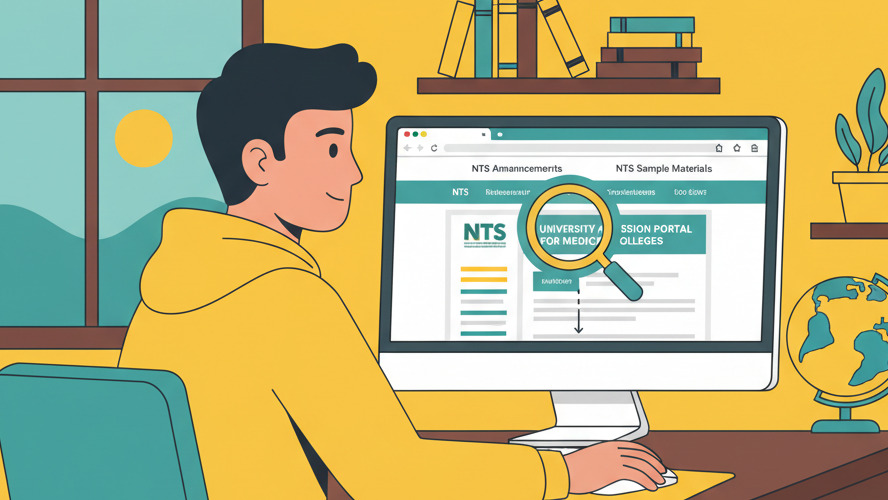
Use these sources first:
- Official NTS channels — announcements, test notices, and any paper-related guidance.
- University admission pages — many medical colleges share test details and sample materials.
- Verified education portals — portals that clearly label year, subject, and source.
- Authorized prep books — books that include solved MCQs with proper explanation.
Be careful with unverified Telegram groups, WhatsApp forwards, and random social media uploads. Some are useful, but many mix old papers with guessed answers. If a PDF has no date, no source, and no subject label, treat it with caution.
When you search for NTS solved past papers PDF, check three things before using it:
- Does it mention the test year?
- Does it match the medical entry format?
- Can you cross-check the questions with another trusted source?
If the file fails any of these checks, do not rely on it for the final revision.
How to Spot Real vs Fake Past Paper PDFs
Fake or low-quality PDFs are common. Some are copied from older exams. Others contain wrong answer keys or mixed subject sets. That is a problem because even one incorrect key can distort your revision.

Here is a simple way to check authenticity:
1. Check the paper structure
Real NTS medical entry test papers usually have a clear subject balance. You should see biology, chemistry, physics, English, and sometimes reasoning or aptitude, depending on the institution.
2. Check the wording style
Authentic papers often use short conceptual MCQs. If a paper looks too easy, too repetitive, or too generic, it may not be current.
3. Check the answer key
Good solved papers usually explain why an answer is correct. If the file only gives letters like A, B, C, or D with no explanation, use it only as a rough practice tool.
4. Check the date
For the medical entry test 2026 in Pakistan, late-2025 and early-2026 material is more valuable than older sets. The closer the paper is to the current cycle, the better it reflects the real pattern.
A practical rule is this: if the source cannot explain where the paper came from, do not treat it as final.
How to Analyze Repeated Questions and Trends
This is where most students miss the real benefit of the NTS medical entry test past papers. They solve a paper once, check the answers, and move on. That does not create great improvement.
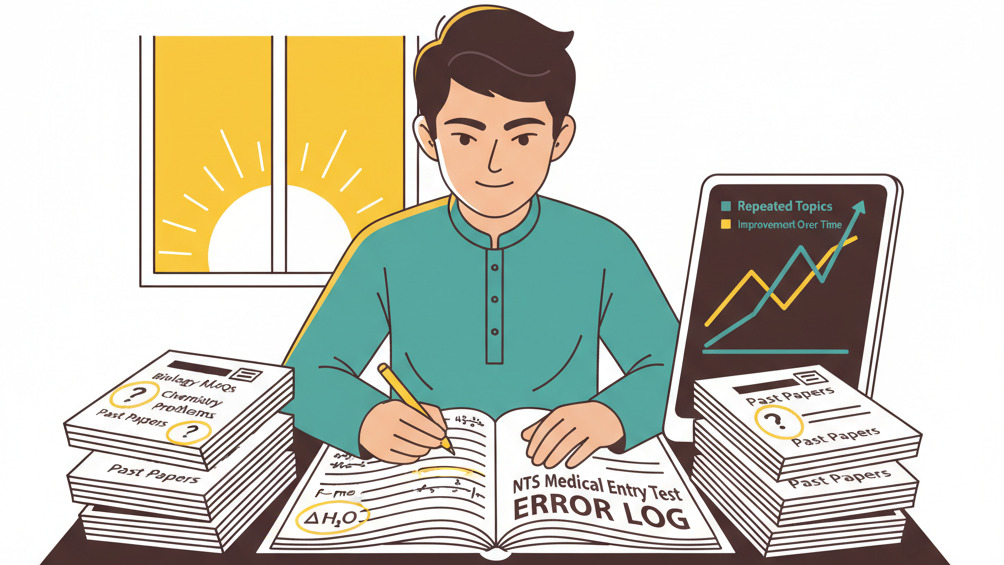
Instead, use a topic-tagging system. After each paper, mark every MCQ by subject and chapter. Then compare papers to see which topics come up again and again.
Step-by-step trend analysis
- Solve the paper under timed conditions.
- Mark each wrong question in an error log.
- Write the topic beside each MCQ, such as cell biology, acids and bases, motion, or grammar.
- Count repeated topics across papers.
- Revise the top recurring areas first.
- Retest yourself after revision.
In medical entry test preparation, repeated patterns often appear in biology concept retention, chemistry reaction recall, physics numericals, grammar rules, and logical elimination. The goal is not to memorize the whole paper. The goal is to understand the kind of question that keeps returning.
For example, if you keep missing questions on enzymes, cell organelles, or human physiology, that is a clear signal. You do not need more random reading. You need focused revision on those exact chapters.
This topic-wise method also helps with MCQ elimination techniques. When you know the pattern, you can remove wrong answers faster and save time on the full paper.
Topic-Wise Study Plan Using Past Papers
A good plan turns papers into daily action. A weak plan turns papers into a pile of PDFs. For 2026, a short and focused routine works better than long, unfocused reading.

Here is a simple study loop you can repeat every week:
- Attempt one paper under exam timing.
- Review every wrong answer and note the reason.
- Group questions by topic and chapter.
- Revise weak topics using notes, books, or concept videos.
- Retake the same paper after 3 to 5 days.
Use this loop across biology, chemistry, physics, English, and reasoning. Keep the same notebook or spreadsheet for your error log. That way, you can see progress week by week.
Here is a simple way to split your time:
- Biology: focus on diagrams, definitions, human body systems, genetics, and cell topics.
- Chemistry: revise reactions, periodic trends, atomic structure, acids and bases, and common formula-based MCQs.
- Physics: practice numericals, units, motion, waves, electricity, and formulas.
- English: work on grammar, synonyms, antonyms, sentence correction, and reading speed.
- Reasoning: practice sequence questions, patterns, and quick logic items if your test includes them.
This method fits both first-time students and repeat aspirants. It also works well for students who need a clear study timetable design and want to avoid burnout.
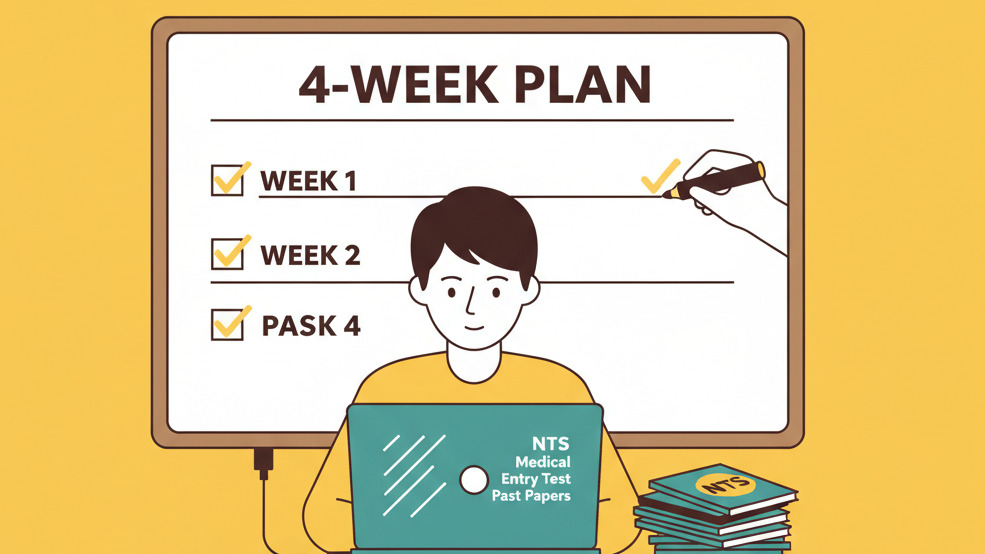
A 4-Week NTS Medical Entry Test Plan
If you have four weeks left, do not try to study everything equally. Use the paper pattern to decide what gets more attention. A 4-week plan works best when it is simple and measurable.
Week 1: Build your base
Start with one recent paper. Then revise the most common topics in each subject. Keep this week slow but structured.
- 1 full paper under timing.
- 2 chapter reviews in biology.
- 2 chemistry topic reviews.
- 1 physics formula sheet.
- 1 English grammar round.
Week 2: Focus on weak areas
Now use your error log. Spend more time on the topics where you lost marks. Do not keep revising what you already know well.
- 2 timed topic tests.
- 1 full-length mock.
- Revision of wrong answers from Week 1.
- Short daily review of key formulas and definitions.
Week 3: Increase speed
This week should improve timed test practice. Solve more questions in less time. Train yourself to move on when a question takes too long.
- 2 full papers under exam timing.
- 1 mixed MCQ drill for biology and chemistry.
- 1 physics numerical set.
- 1 English speed round.
Week 4: Mock and review
The final week is for clean revision. Do not start new topics unless they are very important. Focus on full mocks, answer review, and a calm exam-day rhythm.
- 2 full mocks.
- Review of all wrong questions.
- Quick revision of high-yield chapters.
- Sleep and stress management.
Track your score after each paper. Even a small jump, like 5 to 10 marks, can show that your method is working.
7 Common Mistakes Students Make With Past Papers
Students often work hard but still get weak results because of small mistakes in practice. These errors are easy to fix once you notice them.
- Solving without timing — This creates false confidence. Always practice under time pressure.
- Memorizing answer keys — This helps only for one paper. The exam still needs concept understanding.
- Ignoring wrong answers — Your mistakes are more valuable than your correct answers.
- Using only old papers — Old papers may not match the current difficulty or style.
- Skipping full mocks — Section-wise practice is useful, but full papers build endurance.
- Not tracking progress — If you do not measure scores, you cannot see improvement clearly.
- Ignoring negative marking strategy — If your paper includes it, guessing blindly can lower your score.
These mistakes are common because students want quick results. But NTS medical entry test past papers work best when you treat them like a system, not a shortcut.
Best Complementary Resources for 2026 Preparation
Past papers are essential, but they are not enough on their own. The best students combine them with concept revision and short tests. That gives both depth and speed.
Useful supporting resources include:
- Concept books for biology, chemistry, and physics.
- Chapter tests to check topic-level understanding.
- Short concept videos when a chapter feels unclear.
- Mock test platforms that mimic exam timing.
- Error-log sheets to track repeated mistakes.
Some students also use wider learning platforms like Coursera or Google Career Certificates for confidence and study habits, but for medical entry prep, your main focus should stay on syllabus-linked material. If you are in Pakistan, check local support from HEC Pakistan or AICTE-style institutional guidance where relevant to your academic path.
If you need a broader prep base, you can also explore Trainee.in career guides and the Trainee.In the blog for study and application support.
What Top Scorers Do Differently
Top scorers are usually not studying more hours than everyone else. They are studying with more control. They know where their marks come from and where they lose them.
Most strong candidates do five things well:
- They solve recent papers early.
- They study by topic, not only by chapter order.
- They review every mistake in writing.
- They use timed mock tests weekly.
- They keep a calm routine in the final week.
They also know when to stop reading and start testing. That balance matters. Reading helps you learn. Solving helps you remember under pressure.
Some students also prepare backup plans. That does not mean they expect failure. It means they understand the wider education and career picture. In Pakistan, a medical student’s future earning path can later range from around PKR 60,000 to PKR 140,000 per month for a house officer, and much higher after specialization, often PKR 200,000 to PKR 600,000+ per month depending on the field and experience. For readers who may later look at Gulf options, a general practitioner in the UAE may earn around AED 12,000 to AED 25,000 per month, while specialist physicians can earn AED 30,000 to AED 80,000+ per month.
That wider view matters because medical admission is only the first step. A focused prep plan now can shape your future options later.
How to Use NTS Past Papers in a Weekly Routine
To get the best results from NTS medical entry test past papers, keep a weekly routine. The routine should be realistic enough to follow every day.
A simple weekly format can look like this:
- Monday: one timed biology set
- Tuesday: chemistry revision plus wrong-answer review
- Wednesday: physics numericals
- Thursday: English grammar and vocabulary
- Friday: mixed MCQ practice
- Saturday: full paper under exam timing
- Sunday: error-log analysis and light revision
This routine helps with memory and stress control. It also keeps your work balanced. If one subject is weaker, give it more time, but do not ignore the rest.
Common Mistakes to Avoid
There are a few mistakes that show up again and again in medical entrance exam preparation Pakistan. Avoiding them can save you marks quickly.
- Using only one source for all papers.
- Trusting old PDFs without checking the year.
- Skipping revision after solving papers.
- Studying only the easy chapters.
- Practicing without a timer.
- Ignoring mock-test performance tracking.
- Changing study plans every few days.
If you want to improve, stay with one clear method for at least two weeks. Little progress is easier to measure than constant plan changes.
Frequently Asked Questions
Are NTS past papers enough for medical entry test preparation?
No. NTS medical entry test past papers are essential for understanding the paper pattern and timing, but they are not enough on their own. You should combine them with syllabus-based revision, concept practice, and full-length mocks for the 2026 exam.
Where can I find authentic NTS medical past papers?
Use official NTS announcements, university admission pages, trusted education portals, and verified test-prep books. Avoid unverified Telegram or social media PDFs unless you can cross-check them with trusted sources.
How should I solve NTS past papers effectively?
Solve them in exam conditions and keep strict timing. Then review every wrong answer, tag repeated topics, and reattempt the same paper after revision. That gives you a clear view of progress.
What subjects appear most often in medical entry tests?
Biology, chemistry, physics, and English appear most often. Some tests also include reasoning or general aptitude, depending on the admitting institution.
How many past papers should I practice before the medical entry test?
Try to cover all recent papers you can find, especially the latest NTS past papers 2025 and early 2026 sets. Then complete multiple full-length mocks and repeat the most relevant papers after weak-area revision.
What mistakes should I avoid while using past papers?
Do not memorize answer keys without understanding the concept. Do not skip timing practice, ignore weak chapters, or rely only on old papers that may not match current trends.
Conclusion
If you want better results in the medical admission 2026, use the NTS medical entry test past papers as a core study tool. They help you understand the test style, spot repeated topics, and build speed under pressure.
The best approach is not random practice. It is timed solving, topic tagging, weak-area review, and full mocks. When you use papers this way, your preparation becomes clearer and more useful.
Keep your sources verified, your plan short, and your revision focused. That is usually better than trying to study everything at once.
For more practical study and career support, visit the Trainee.in blog and explore the career guides section for more helpful resources.
