


LUMHS Jamshoro is one of the most important names for students who want a medical and health sciences career in Pakistan. If you are planning your next step in 2026, the university deserves a close look because it combines admissions, teaching hospitals, clinical training, and research in one place.
This guide explains LUMHS Jamshoro admissions 2026-2027, the main programs, student life, research options, and career outcomes. It also covers the details most applicants search for first, such as eligibility, merit, fees, hostels, and future job paths.
LUMHS Jamshoro at a Glance
LUMHS Jamshoro, or Liaquat University of Medical & Health Sciences Jamshoro, is known for medical and allied health education in Sindh. It serves students who want MBBS, BDS, nursing, allied health, and postgraduate training.

For many families, the main question is simple: Does the degree lead to real clinical exposure and a stable career? At LUMHS, that answer depends on hospital access, faculty quality, and the chance to learn in a busy medical setting.
- Main focus: medical, dental, nursing, and health sciences education
- Location: Jamshoro, Sindh
- Student value: clinical training, teaching hospitals, and postgraduate pathways
- Best for: students who want a practical route into medicine and health care
If you are comparing options across medical career guides, LUMHS stands out because it is not only about lectures. It is also about hospital learning, research, and long-term career planning.
Why Choose LUMHS for Medical and Health Sciences
Students do not choose a medical university only for its name. In 2026, they look at patient volume, lab access, hospital links, and the strength of the training environment. That is where LUMHS Jamshoro becomes relevant for many applicants.

The university is often chosen by students who want affordable public-sector medical education with serious clinical exposure. It also matters for those who plan to stay in Pakistan for a house job, residency, or specialist training, while keeping the door open for Gulf and global options later.
What makes LUMHS practical for students
- Direct exposure to clinical settings and teaching hospitals
- Programs across MBBS, BDS, nursing, and allied health
- Research opportunities that can support postgraduate applications
- Lower cost compared with many private medical colleges
- A public university setting that many families trust
Students who search for LUMHS Karachi or Jamshoro college comparison usually want one thing: value. They want a place where the degree, training, and career outcomes justify the effort and cost.
Admissions Process 2026-2027
The most useful admission advice for LUMHS Jamshoro admissions 2026-2027 is also the simplest: always verify the current prospectus and official notice before applying. Deadlines, quotas, fee details, and document rules can change from year to year.

For MBBS and other medical programs, applicants usually need to follow a checklist-based process. That is now the standard expectation for medical colleges in Sindh 2026, and it is especially important for families managing forms, fees, and verification steps.
Typical admission steps
- Read the latest official admission notice and prospectus.
- Check whether you meet the academic eligibility criteria.
- Confirm the required entry test, usually MDCAT or the current approved test route.
- Complete the online application form on the official portal.
- Upload scanned documents in the required format.
- Pay the application fee, if required.
- Track the merit list, interview, or verification schedule.
- Complete admission confirmation before the deadline.
Applicants searching for the LUMHS MBBS merit list should expect updates through official university channels. Third-party pages often repeat old information, so it is better to verify every step directly.
Documents usually needed
- Matric and FSc or equivalent marksheets
- CNIC or B-Form
- Passport-size photographs
- Domicile and PRC, if applicable
- Entry test result card
- Any quota or reserved seat documents
- Affidavits or certificates are asked for in the prospectus
When parents ask about Liaquat University of Medical & Health Sciences, Jamshoro admissions 2026, they usually want a clear timeline. The best answer is to prepare early, because medical admissions often close faster than students expect.
Eligibility Criteria, Entry Test, and Merit Calculation
The LUMHS admission criteria for MBBS 2026 will be based on the current rules announced by the university and the relevant Sindh authorities. In most cases, students must have science subjects in intermediate education and meet the required marks threshold.
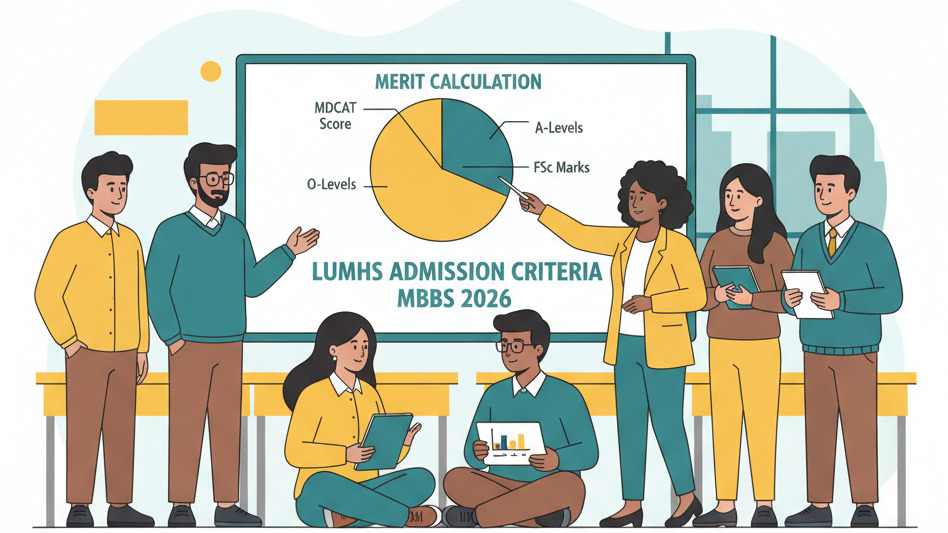
Entry tests matter a lot. If the university requires MDCAT or another approved entrance route, your score can strongly affect your merit position. This is why students should treat the test as seriously as their board exams.
What merit usually depends on
- FSc or equivalent marks
- Entry test score
- Any interview or verification rule, if announced
- Reserved seat or quota category
- Government policy for public-sector medical seats
Many students search for LUMHS entry test details at the last moment. That is risky. The smarter move is to check the official notice early, then build your preparation plan around the expected test date.
If you are also comparing admissions across Pakistan, look at the wider picture. In public medical universities, merit is often tighter than students expect, especially for MBBS and BDS. A strong entry test score can make a real difference.
Quota and reserved seats
Quota seats can include categories such as provincial, district, disabled, foreign, or other government-notified groups. The exact structure changes with policy, so do not rely on old blogs. Read the official prospectus for the current year.
LUMHS Jamshoro Programs
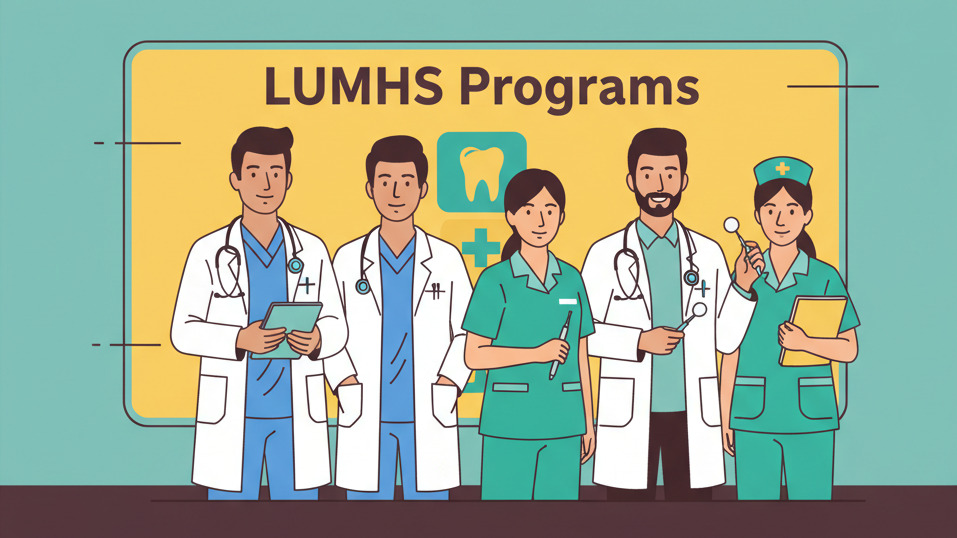
The range of LUMHS Jamshoro programs is one reason students consider the university a full-stack health sciences institution. It is not just a single-degree campus. It covers undergraduate and postgraduate tracks across several health fields.
Undergraduate programs at LUMHS
- MBBS: the core medical degree for future doctors
- BDS: the dental degree for clinical dentistry paths
- Nursing: for bedside care, hospital work, and advanced nursing roles
- Allied health disciplines: for diagnostic, technical, and support roles in health care
These programs matter because the health sector does not run on doctors alone. Labs, wards, diagnostics, and hospital systems all need trained professionals. That is why allied health and nursing are gaining more respect in 2025 and 2026.
Postgraduate and specialty training
LUMHS postgraduate programs are important for students who want to specialize after MBBS or BDS. Depending on the current prospectus, this can include MD, MS, diplomas, and fellowship-style training routes.
Postgraduate education becomes more valuable when students already have strong clinical habits. Good hospitals, case exposure, and research work can help build that foundation early.
For students who want broader career advice after graduation, see career guides for health students and salary trends across medical roles.
Campus Life, Hostels, and Student Facilities
Campus life matters more than many applicants admit. Medical study is intense, so students need a place that supports long hours, safe living, and study time. Families also look at these details before they commit.
When people search for LUMHS hostel facilities, they usually want the basics: room quality, safety, food, distance from classes, and transport. These are not small issues. They affect attendance, sleep, and daily performance.
Facilities students usually care about
- Hostels for boys and girls, if available in the current intake
- Library access for study and exam prep
- Skills labs for clinical practice
- Transport for commuting between the campus and the hospital sites
- Sports and recreation spaces
- Student societies and academic groups
Students often ask whether the campus feels too academic and serious. In a medical university, that is normal. But a healthy campus still needs balance, and sports, societies, and student spaces help with that.
Why facilities matter in 2026
Medical students now expect more than classrooms. They want skills labs, digital resources, and better learning support. This shift fits the wider trend seen in 2025, where short-term internships grew by 63% in a referenced market report. Students want structured, career-linked learning, not just theory.
That same trend explains why students now ask about hospital rotations, electives, and house job pathways earlier than before. They want to see how the degree turns into work.
Clinical Training, Teaching Hospitals, and Practical Exposure
For a medical university, clinical training is the real test. A student may read well, but patient care needs practice, judgment, and calm communication. That is why LUMHS Jamshoro is judged not only by its course list, but by the training it gives in hospitals and labs.
Clinical exposure builds skills that matter in every health setting. These include clinical reasoning, patient communication, medical ethics, diagnostic interpretation, and evidence-based medicine.
What practical training should you give them?
- Bedside learning with real patients
- Case discussion with faculty
- Lab and diagnostic interpretation practice
- Exposure to emergencies and routine ward work
- Early understanding of hospital workflow
Students who want stable careers often ask about LUMHS house job opportunities after graduation. That question is fair. House jobs are the bridge between student life and real practice, and they matter for pay, confidence, and future specialization.
Pakistan medical training insight:
- House officer / medical intern: PKR 40,000-90,000 per month
- Medical officer / general practitioner: PKR 90,000-180,000 per month
- Resident / postgraduate trainee: PKR 80,000-180,000 per month
- Specialist physician: PKR 200,000-600,000+ per month
These numbers vary by province, institution, and experience. Private hospitals may pay differently from public-sector posts. Night duties, city tier, and specialty also affect salary.
Research, Innovation, and Publication Culture at LUMHS
Research is no longer a side topic for medical students. It now shapes residency applications, conference profiles, and postgraduate opportunities. That is why a strong research culture is one of the best reasons to study at a university like LUMHS Jamshoro.
Medical students today want real chances to join studies, write papers, and present work. They also want help with research methodology, biostatistics, and professional writing. Those are useful skills whether you stay in Pakistan or apply abroad later.
Why research matters for students
- It improves evidence-based clinical thinking
- It strengthens postgraduate and residency applications
- It helps with conference presentations
- It builds confidence in scientific writing
- It supports long-term careers in public health and diagnostics
The best universities make research feel practical. Students should be able to join projects, learn from faculty, and understand how data supports patient care. Even one good project can improve a CV more than several weak activities.
Students preparing their academic profile can also use the CV writing guide to present research, internships, and training in a clear way.
Career Paths After LUMHS
The career value of LUMHS Jamshoro comes from what you do after graduation. The degree opens doors, but skills decide how far you go. This is true in Pakistan, the Gulf, and other health systems.
Graduates can move into hospital practice, postgraduate training, diagnostics, research, public health, or administration. Many students also build careers in the UAE and other Gulf markets if they meet licensing rules and experience requirements.
Common career paths
- House job and internship: the first practical step after MBBS
- Medical officer or GP: work in clinics, hospitals, and care centers
- Postgraduate training: specialize through MD, MS, or diplomas
- Public health: work in policy, disease control, and community health
- Diagnostics and labs: support testing and clinical decision-making
- Biomedical research: join research teams, labs, or academic projects
- Hospital administration: manage services and workflows
For Gulf planning, the salary picture is different. Licensing matters a lot, and employers look for experience.
UAE market insight:
- General practitioner / medical officer: AED 15,000-35,000 per month
- Specialist doctor: AED 30,000-70,000+ per month
These ranges depend on specialty, employer, licensing authority, and years of practice. Many graduates start in Pakistan, then move after gaining experience and the right credentials.
If you are comparing local and overseas outcomes, it helps to look at wider job options and health career articles before making a final choice.
Alumni Success Stories and Global Recognition
Students and parents often ask about LUMHS alumni because alumni outcomes are one of the best signs of institutional value. A strong alumni network usually means graduates have moved into hospitals, teaching, research, and public service roles.
It is better to think about alumni success in practical terms. Where do graduates work? How many move into specialist training? How many build careers in Pakistan, the Gulf, or academia? Those are the right questions.
What strong alumni outcomes usually look like
- Doctors in public and private hospitals
- Specialists and consultants after postgraduate training
- Researchers and university faculty members
- Health managers and public health professionals
- Clinicians working in Gulf healthcare systems
Global recognition does not mean every graduate leaves the country. It means the training is solid enough to support different paths. That includes local hospital work, exam preparation, and international licensing goals where allowed.
In 2025, internship interest in the UAE increased by 54% in a referenced report. That trend matters here because it shows South Asian students increasingly want training that travels well across borders. Medical education now has to support both local service and international mobility.
LUMHS vs Other Public Medical Universities in Sindh
Students often compare LUMHS with other public medical universities in Sindh. The usual points are affordability, clinical volume, research access, and postgraduate support. That comparison is reasonable, especially when families are paying attention to return on investment.
LUMHS is often viewed as strong for practical training and hospital-based learning. Other universities may differ in location, hospital network, or research style. The right choice depends on where you live, what specialty you want, and how much you value hostel life and campus access.
- Affordability: the public-sector structure often makes LUMHS more accessible than private colleges
- Clinical volume: teaching hospital exposure is a major factor for learning
- Research access: students should check labs, mentors, and publication support
- Residency preparation: look at house job, exam support, and faculty guidance
This is why the phrase medical colleges in Sindh 2026 is not just a search term. It reflects a real choice families are making about cost, training, and long-term career value.
Common Mistakes to Avoid
Many applicants lose time because they rely on old advice or incomplete posts. Medical admissions are detail-heavy, so small mistakes can become expensive.
- Missing the official deadline: admission windows can close quickly
- Using old fee information: the LUMHS fee structure 2026 must be checked from the current notice
- Ignoring quota rules: reserved seats need the right documents
- Preparing for the entry test too late: merit often depends on this score
- Choosing a college only by name: clinical training matters more than branding
- Skipping hostel and transport checks: daily comfort affects study performance
- Not asking about house job pathways: the post-degree plan should be clear
Another common mistake is treating research as optional until the final year. That approach is weak. Good applications, especially for postgraduate paths, benefit from early research and presentation experience.
Frequently Asked Questions
What is the admission process for MBBS at LUMHS Jamshoro in 2026-2027?
Applicants should confirm the latest university and Sindh admission notice, check eligibility based on FSc or equivalent science subjects, and meet the required entry-test criteria. After that, they need to submit the online form, upload documents, and track the merit list and any verification steps.
Which undergraduate programs are typically offered by LUMHS?
LUMHS is known for medical and health sciences programs such as MBBS, BDS, nursing, and allied health-related disciplines. The exact list can change with the current prospectus, so students should review the official admission booklet before applying.
Does LUMHS offer postgraduate training?
Yes. The university is relevant for postgraduate medical education, specialization, and clinical training pathways. Students should verify current MD, MS, diploma, and fellowship offerings from the official postgraduate section.
What student facilities matter most at a medical university like LUMHS?
Applicants usually look for hostels, library access, laboratories, teaching hospitals, transport, clinical skills labs, student societies, sports, and safety infrastructure. These facilities can affect both study quality and daily life.
How can LUMHS help graduates build a career in Pakistan or abroad?
A medical degree becomes more valuable when it is supported by strong clinical exposure, exam readiness, research activity, and postgraduate specialization. These factors improve prospects for hospital jobs, residency training, research, and health-sector roles in Pakistan and the Gulf.
Is research important for LUMHS students?
Yes. Research helps students build publication profiles, present at conferences, and strengthen residency applications. It also develops evidence-based clinical thinking, which is useful in every branch of medicine.
Future of Healthcare Education at LUMHS
The future of LUMHS Jamshoro will likely be shaped by three things: digital learning, stronger research, and a bigger focus on employability. Medical education is changing, and students now expect more than lectures and exams.
Healthcare in Pakistan and the Gulf is also changing. Demand is growing in medicine, diagnostics, public health, biomedical research, telemedicine, and health administration. That means students need more than book knowledge. They need practical judgment, communication, and the ability to work in modern systems.
This is where the university can stay relevant. If it keeps improving clinical exposure, publication support, and postgraduate pathways, it can continue to serve students who want both local careers and global mobility.
Conclusion
LUMHS Jamshoro is a strong option for students who want medical and health sciences education with real clinical value. Its strength lies in the combination of admissions access, teaching hospitals, training, and postgraduate potential.
If you are planning LUMHS Jamshoro admissions 2026-2027, focus on the official notice, entry test rules, merit details, and documents first. Then compare the programs, facilities, and career paths practically. That approach will help you make a better choice for your future.
If you want more support on medical admissions, careers, or student planning, explore the latest career guides and Trainee.in blog articles for clear, useful next steps.
