


Choosing the best medical schools in Pakistan is one of the biggest decisions in a future doctor’s life. In 2026, the choice is not only about name or old reputation. You also need to look at PMC recognition, admission merit, teaching hospitals, research, and graduate outcomes.
Many students start with a dream of MBBS, but later realise that the college shapes their training, confidence, and career options. A strong medical school can give you better clinical exposure, stronger faculty support, and a smoother path to a house job and specialization. This guide explains what to check, which colleges stand out, and how to choose the right fit for your goals.
For related career planning, you can also explore career guides, find jobs, and the Trainee.in blog for more practical advice.
Why Choosing the Right MBBS College Matters in 2026
MBBS in Pakistan 2026; the college you choose affects more than your degree. It affects the kind of patients you see, the teachers who guide you, and the support you get during pressure-filled years. It also affects how ready you are for house job, FCPS, USMLE, PLAB, or Middle East licensing paths.
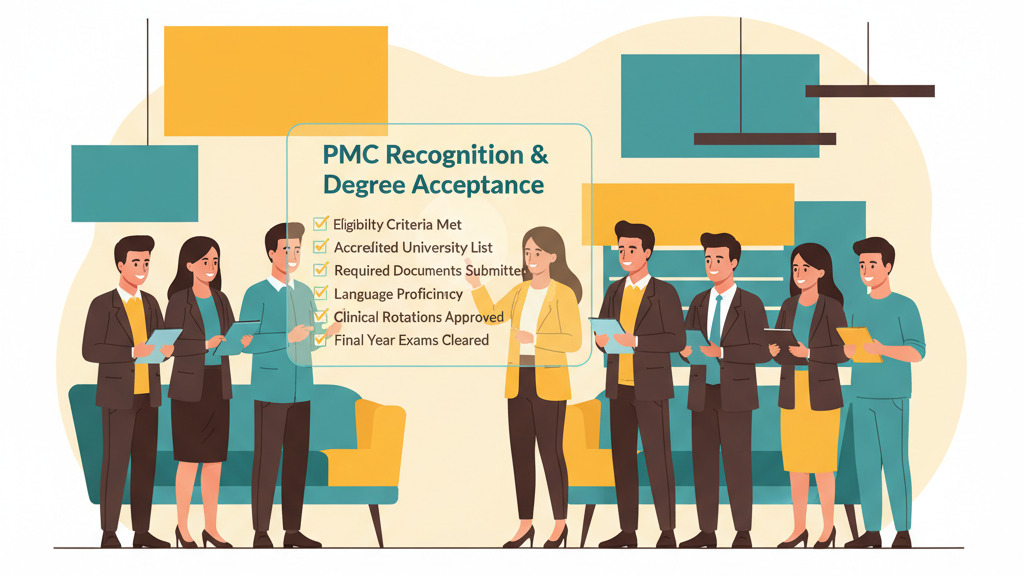
The strongest schools usually stand out because of their real training quality. That means a busy teaching hospital, good labs, regular bedside teaching, active faculty, and a culture that supports study and research. A famous name alone is not enough.
Students and parents are also asking sharper questions now. They want to know if a school is recognized by the Pakistan Medical Colleges list, whether the degree is accepted for licensure, and whether the fee matches the return on investment. That is a sensible way to think about medical education in Pakistan in 2026.
What matters most in a good medical college
- PMC recognition and clear degree acceptance
- Strongly affiliated teaching hospital
- Useful clinical exposure from early years
- Qualified and accessible faculty
- Research culture and publication support
- Safe hostel, transport, and student support
- Reasonable fees for the training offered
How PMC Recognition and Admission Rules Work
Before you compare brand names, check PMC recognition. This step is non-negotiable. If a college is not properly recognized, your degree can create problems later for a house job, postgraduate training, or licensure pathways.
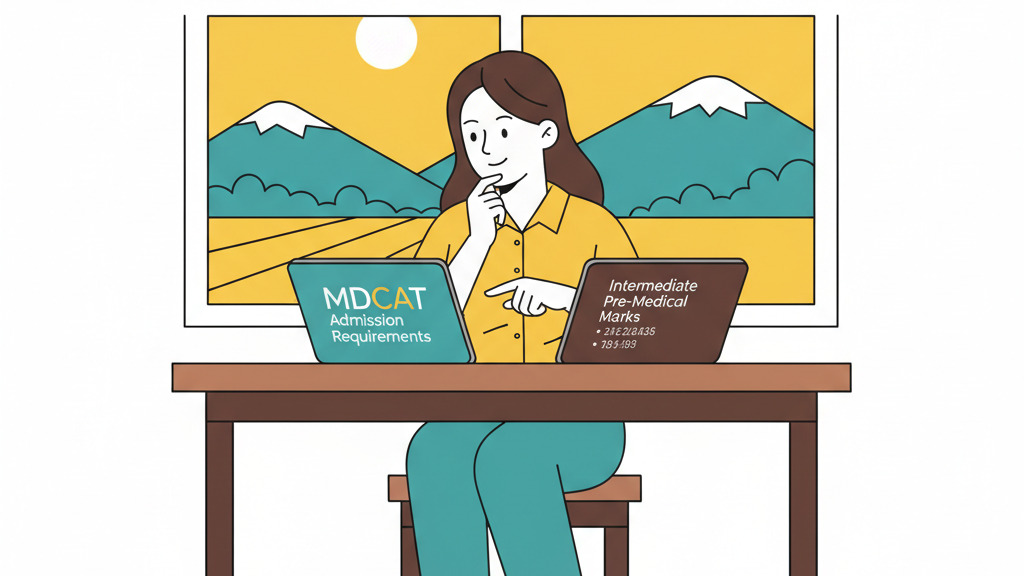
For 2026 admissions, MDCAT admission requirements remain the main entry filter for most MBBS seats in public and many private colleges. Merit usually depends on Intermediate pre-medical marks plus MDCAT performance, with province and institution-specific rules added on top. Some colleges also apply quota rules for open merit, provincial seats, overseas seats, or self-finance options.
Do not assume every college uses the same formula. That is where many students get confused. One college may rank students mainly on MDCAT and FSc marks, while another may add interview or document checks. Always read the official admission notice.
What to verify before applying
- PMC recognition status of the college and its hospital
- Eligibility based on FSc or equivalent pre-medical marks
- Minimum MDCAT score or merit formula
- Quota categories and seat distribution
- Fee structure, late fee, and hostel charges
- Last date, merit list schedule, and document requirements
For students planning early, merit calculator tools and admission notices can save time. Also, check university websites and official provincial admission portals. That matters more than social media posts or old rumours.
MBBS Program Structure in Pakistan
The MBBS degree in Pakistan is usually a 5-year academic program, followed by a house job or internship. This structure is important because the final goal is not only passing exams. The goal is to become safe, practical, and ready for clinical work.
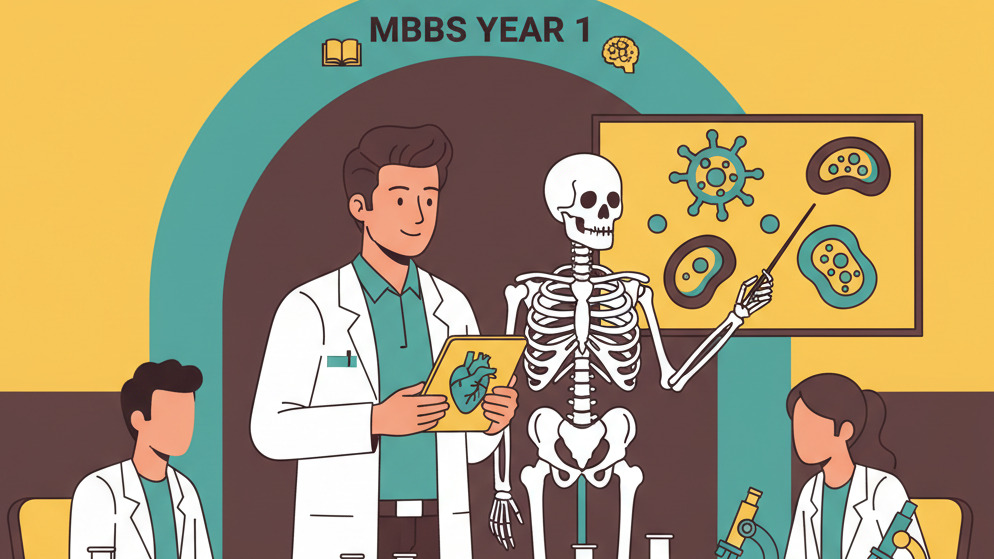
The program is generally split into pre-clinical, para-clinical, and clinical phases. In the early years, you study anatomy, physiology, biochemistry, and related basic sciences. Later, you move into pathology, pharmacology, community medicine, forensic medicine, and clinical subjects like medicine, surgery, gynecology, pediatrics, and more.
After the academic years, the house job gives you supervised,d hands-on training. This is where many students finally connect textbook knowledge with real patients. Strong colleges usually prepare students better for this stage because they have active wards, regular case discussions, and better access to teaching hospitals.
Typical MBBS journey
- Year 1–2: Basic sciences and early anatomy/physiology work
- Year 3: Paraclinical subjects and introduction to clinical thinking
- Year 4–5: Clinical rotations, ward learning, case presentations, exams
- After graduation: House job/internship and then specialization or practice
If you want to build strong study habits for MBBS, focus on anatomy and physiology fundamentals, exam strategy, and recall techniques. These skills matter from day one.
Top Medical Schools in Pakistan: What Sets Them Apart
There is no single official public list that solves everything for every student. Still, some colleges are widely respected because they combine recognition, hospital training, faculty quality, and graduate outcomes. The best medical schools in Pakistan often include a mix of public, semi-government, and private institutions.

Here is a practical shortlist often discussed by students, doctors, and admission teams in 2025–2026. This is not a perfect ranking, but it is a useful comparison point for PMC rankings 2026 style research.
- King Edward Medical University, Lahore — long reputation, strong clinical exposure, major public teaching hospital environment
- Aga Khan University, Karachi — strong research culture, selective admission, strong hospital system, good postgraduate placement
- Dow University of Health Sciences, Karachi — a large clinical network, research activity, and broad patient exposure
- Allama Iqbal Medical College, Lahore, is a respected public college with strong teaching hospital links.
- Nishtar Medical University, Multan — known for clinical workload and practical training
- Khyber Medical College, Peshawar — established name, wide regional influence, active clinical learning
- Fatima Jinnah Medical University, Lahore — strong for women’s medical education and clinical learning
- Shifa College of Medicine, Islamabad — private option with hospital exposure and structured training
- Liaquat National Medical College, Karachi — known for hospital-backed clinical learning
- CMH Lahore Medical College — private/semi-private choice with controlled environment and teaching hospital support
What sets these schools apart is not the logo. It is what happens inside the wards, labs, and classrooms. If a college gives you more real patient contact and better teachers, it often prepares you better for the career after MBBS in Pakistan.
Public vs Private Medical Colleges: Cost, Quality, and Outcomes
Many families compare public and private colleges only by the fee. Fee matters, but it is not the only factor. The right question is whether the total cost matches the training, clinical exposure, and future value.
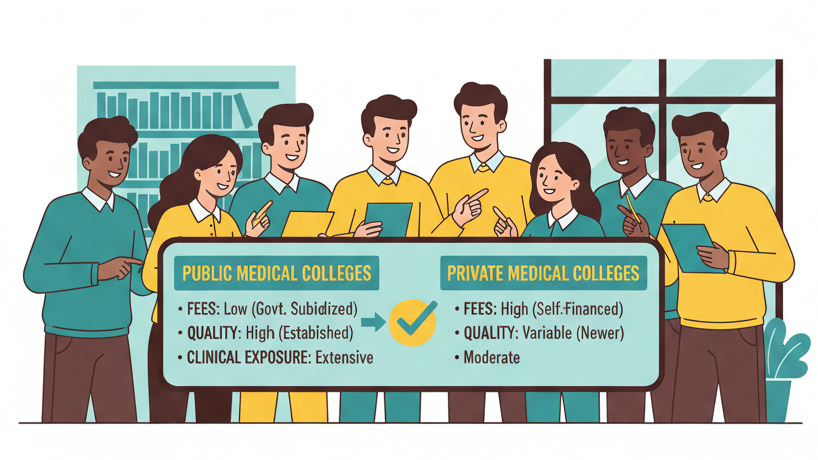
Public medical colleges generally cost much less than private ones. That makes them highly competitive and often the first choice for high-merit students. Private medical colleges in Pakistan have high fees, but some students still choose them for location, environment, or if they cannot secure a public seat.
Simple comparison
- Public colleges: lower tuition, stronger competition, usually better value for high-merit students
- Semi-government colleges: middle-range fees, mixed admission models, decent hospital access in many cases
- Private colleges: higher fees, faster seat access for some applicants, quality varies a lot by institution
In Pakistan, a public MBBS seat can be the most affordable route by far. Private tuition can vary widely, so always check the total cost, not just tuition. Add hostel, transport, books, lab fees, and exam charges before deciding.
Fee and market insight by region
- Pakistan public colleges: lower tuition; often the best ROI for top-merit students
- Pakistan private colleges: fees can be very high and differ by city and brand; check each college separately
- India: useful as a benchmark for families comparing regional medical education costs, especially private MBBS options
- UAE: Many students look at Gulf options for future licensing or postgraduate routes, but MBBS pathways and costs differ from those in Pakistan
If your budget is tight, look closely at public options and recognized semi-government schools first. If you are considering a private college, compare graduate outcomes and hospital training, not marketing language.
Faculty, Research, and Teaching Hospital Quality
Faculty quality matters because medicine is a practical field. A college can have a nice building, but if the teachers are absent or the hospital is too quiet, your learning can suffer. That is why many students now compare schools by teaching hospital load and research output.
Graduates who plan postgraduate training often prefer colleges with stronger affiliated teaching hospitals. This helps with case exposure, recommendation letters, FCPS preparation, and better clinical confidence. It also helps students build research literacy and scientific writing skills.
What to look for in faculty and research
- Full-time professors and consultants in key departments
- Regular ward teaching and bedside sessions
- Published papers or active research centres
- Student access to journals, libraries, and writing support
- Opportunities for audit, poster work, and conference participation
For example, colleges linked with major hospitals in Karachi, Lahore, Islamabad, and Peshawar often give broader case exposure than smaller private setups. But you should still check each campus and hospital on its own merit. Some private colleges do well because their affiliated hospitals are active and structured.
This also matters for students interested in USMLE, PLAB, or Gulf routes. Strong academic discipline, clinical exposure, and research experience can help later when you apply abroad.
Campus Life, Hostel Facilities, and Student Support
Campus life may sound less important than academic marks, but it affects performance a lot. Medical school is long and stressful. If the hostel is unsafe, transport is unreliable, or the library is weak, your daily life gets harder.
Good colleges usually have proper hostels, secure transport, practical labs, simulation centres, libraries, and student societies. Some also offer counselling or mental-health support, which matters more than many people admit. Long study hours become easier when the environment is stable.
Student life factors to ask about
- Separate and secure hostel options
- Transport routes and timings
- Library hours and digital resources
- Clean labs and skills/simulation labs
- Sports, societies, and peer support
- Safety, campus entry rules, and medical support
Try to speak to current students before applying. Their answers are often more useful than the prospectus. Ask about ward duty, hostels, food, Wi-Fi, exam pressure, and how approachable the faculty is.
Career Paths After MBBS in Pakistan
The career after MBBS in Pakistan is wider than many first-year students think. Some graduates go into a house job and then FCPS or MCPS. Others join public hospitals, private clinics, teaching, research, or international licensing paths.
In Pakistan, the usual next step is a house job. After that, many doctors prepare for specialization. Others choose general practice, family medicine, or roles in NGOs, telemedicine, and hospital administration.
Common career routes after graduation
- House job/internship for practical training and experience
- FCPS or MCPS for specialization in a chosen field
- Medical officer or general practitioner role in clinics or hospitals
- Teaching and research in medical colleges or universities
- International licensing,g such as USMLE, PLAB, or Gulf routes
When students compare the best medical schools in Pakistan, they should ask a simple question: Do graduates from this college do well later? If a college consistently sends students into strong residencies, specialty training, or international exams, that is a meaningful sign.
Alumni Outcomes and Specialization Opportunities
Alumni success is one of the best ways to judge a college. Ask where graduates go after MBBS. Do they clear FCPS? Do they get jobs in good hospitals? Do they move into research or licensing abroad?
Colleges with strong alumni networks often help students in more practical ways than they advertise. Alumni can guide juniors about exam strategy, house job choices, and specialty selection. They can also offer references and useful advice about working in Pakistan or abroad.
Typical earnings and market insight
- House officer/house job doctor in Pakistan: pay varies widely by hospital and city; public and private hospitals should be checked directly
- Medical officer or general practitioner: compensation varies by sector, city, and employer; private clinics may offer higher upside but less stability
- Specialist after FCPS/MCPS: income is highly variable and usually much higher than general practice, depending on specialty and location
- MBBS graduate pursuing licensing abroad: earnings depend on country, exam success, postgraduate training, and registration status
Public-sector jobs usually have more structure. Private practice can bring more upside later, but it also needs reputation and experience. Abroad, the path can improve income further, but only after licensing, training, and time.
How to Choose the Right Medical School for Your Goals
This is where your decision should become practical. Do not choose only because your friends are going there. Choose based on your marks, budget, city preference, learning style, and long-term plan.
A simple decision checklist
- Confirm the college is PMC-recognized and degree-accepted.
- Check your merit against the latest admission criteria.
- Compare the teaching hospital's strength and patient volume.
- Review faculty profiles and research culture.
- Look at fees, hostel cost, and transport cost.
- Ask about campus safety and student support.
- See where alumni usually work after graduation.
If you want research-heavy training, choose a college known for publications and academic culture. If you want stronger bedside learning, prioritise a busy teaching hospital. If budget matters most, public colleges usually give the best value.
For students who are still comparing options, tools like a merit sheet, fee comparison, and college-by-college hospital review can help. You can also use Trainee.in resources such as salary trends and career guides to plan the next stage after MBBS.
Common Mistakes to Avoid
Many students make the same mistakes when choosing from the top MBBS colleges in Pakistan. These mistakes are avoidable if you slow down and check the facts.
- Choosing a college only because it has a famous name
- Ignoring PMC recognition and degree acceptance
- Not checking the hospital patient load
- Looking at tuition,n but forgetting hostel and transport costs
- Assuming all private colleges offer the same quality
- Not asking seniors about ward teaching and exam pressure
- Skipping the merit formula and quota details
One more mistake is treating MBBS like a short degree. It is a long training path. The school you choose affects your next six to ten years, not just your first exam.
Frequently Asked Questions
What should I check first when choosing an MBBS college in Pakistan?
First, to verify PMC recognition and degree acceptance. Then compare admission merit, affiliated teaching hospital quality, tuition, location, and postgraduate outcomes. That sequence protects you from making a costly mistake.
Is a higher PMC ranking always the best choice?
Not always. Ranking matters, but hospital exposure, faculty strength, case load, and affordability can matter just as much. The best choice is the one that fits your goals and resources.
What are the usual admission requirements for MBBS in Pakistan?
Most applicants need strong FSc or Intermediate pre-medical marks and a competitive MDCAT score. Some colleges also apply province-specific rules, quotas, or additional eligibility checks. Always read the official admission notice.
How long is the MBBS program in Pakistan?
MBBS is generally a 5-year degree followed by a house job or internship period. That practical year is essential for clinical readiness and future specialization.
What career options are available after MBBS?
Graduates can do house jobs, FCPS or MCPS specialization, private practice, public-sector jobs, teaching, research, or international licensing routes such as USMLE and PLAB. Many doctors combine more than one path over time.
Are private medical colleges worth it?
They can be worth it if the college is recognized, the hospital training is strong, and the finances are manageable. But you should compare total cost and graduate outcomes carefully before paying high fees.
Conclusion
Choosing among the best medical schools in Pakistan takes more than a quick ranking check. In 2026, you should compare PMC recognition, admission merit, hospital exposure, faculty quality, campus support, and alumni outcomes. That gives you a clearer picture of value, not just reputation.
If you are serious about medicine, take time with the decision. The right college can support your learning, your confidence, and your career after MBBS in Pakistan. The wrong one can make a hard degree even harder.
For more practical planning help, visit the Trainee.in blog and explore career guides for more student-focused advice.
For more student-focused guidance on admissions, careers, and fees, keep exploring Trainee.in and use the right college data before you apply.
